The most expensive security failures I am called in to assess almost never start with a clever exploit. They start with a decision made in a meeting — a decision that felt reasonable at the time, that nobody in the room was equipped to challenge, and that quietly set the blast radius of an incident that arrived eighteen months later. An authentication boundary drawn in the wrong place. A trust assumption between two services that was never written down because everyone assumed someone else owned it. An administrative interface that shared a network path with the public one because splitting them would have slipped the release.
None of those are bugs in the code. They are decisions. And by the time they surface — in a penetration test if you are fortunate, in an incident if you are not — the cost of unwinding them has grown by an order of magnitude, because the system, the integrations, and the customer commitments have all been built on top of them.
Threat modeling is the discipline that surfaces those decisions while they are still cheap to change. For a security leader, it is not a technical exercise to delegate and forget. It is one of the highest-leverage risk-management activities you own, and whether your organisation does it well is a question you should be able to answer with evidence. This article is about what it actually buys you, and how to tell the real thing from the theatre.
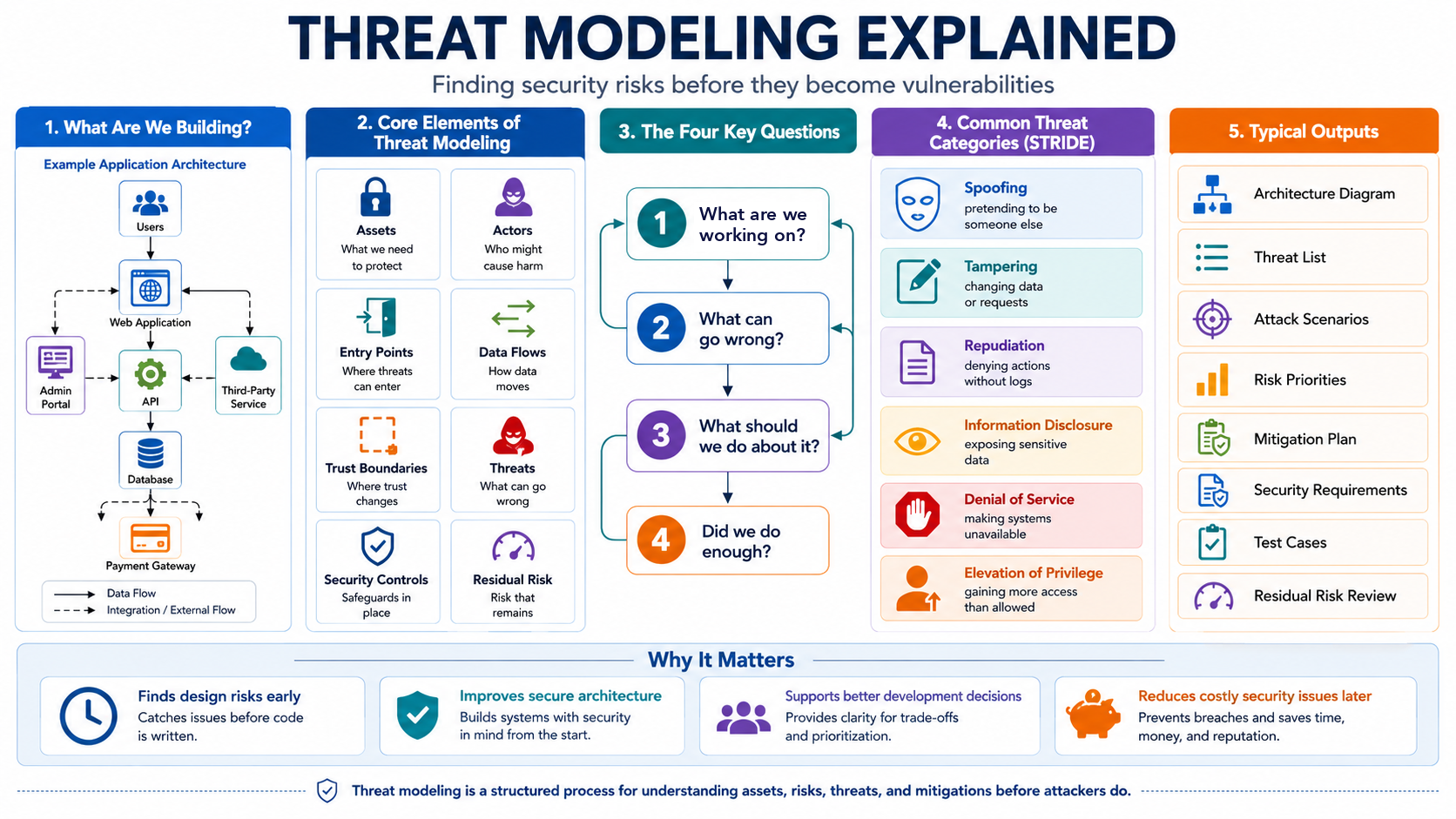
What you are actually buying
Strip away the frameworks and threat modeling is a structured way to answer four questions about a system, ideally before it is built: What are we working on? What can go wrong? What are we going to do about it? Did we do a good enough job? The formulation is Adam Shostack’s, and it has endured because it maps to how the work genuinely flows rather than to any vendor’s methodology.
What that buys a leader is not a document. It is three things that are hard to get any other way.
The first is risk you can see before you have paid to build it. A design flaw caught in a modeling session costs a conversation. The same flaw caught in a penetration test costs a remediation sprint and a slipped date. Caught in production, it costs an incident, a disclosure, and a quarter of trust. Threat modeling is the only activity that operates at the earliest and cheapest point on that curve — before the code exists. Every other control you fund operates later and costs more.
The second is a shared, honest picture of your own system. In most organisations, the clearest architecture diagram in existence is the one produced during a threat-modeling exercise, because it is the only time anyone was forced to reconcile how the system is actually deployed with how the wiki says it is. That picture has value well beyond security; more than once I have watched an engineering leader learn something about their own data flows in a threat-modeling session that changed a roadmap decision.
The third is defensibility. When you accept a risk — and you will, constantly — threat modeling is what turns that acceptance into a decision someone made on purpose, with their name on it, rather than a gap nobody noticed. That distinction is the entire difference between a mature security program and a lucky one, and it is the first thing a regulator, an auditor, or a board risk committee will probe after an incident.
What “good” produces — and what to demand
You do not need to run the exercise yourself. You need to know what competent output looks like, so you can tell when you are getting it. A threat model that has earned its cost produces artifacts your organisation can act on, not a filed-away deck:
- An architecture and data-flow diagram that reflects the system as built, with the trust boundaries marked — the lines where the level of trust changes, which is where nearly every meaningful threat lives.
- A threat list where each threat is tied to a specific element of that diagram, not a generic checklist pasted from a standard.
- Attack scenarios — the narrative of how an adversary would actually chain steps together — because that is what moves a product team, where an abstract category never will.
- Risk priorities, so the response is proportionate and the expensive threats get the expensive attention.
- Security requirements and test cases that flow directly into the backlog and QA. This is the step that separates a threat model which changes the code from one that decorates a wiki.
- A residual-risk review — an explicit accounting of what remains unaddressed and why, so accepting that risk becomes a deliberate decision rather than an oversight nobody owns.
If what comes back to you is a spreadsheet of STRIDE categories with no diagram, no scenarios, and no tickets, you have paid for the theatre and not the thing.
The rigor underneath — and where it quietly fails
The engine most teams use to answer “what can go wrong” is STRIDE: a checklist of six categories — Spoofing, Tampering, Repudiation, Information disclosure, Denial of service, and Elevation of privilege — applied deliberately to each element of the model. Its value is that it is mechanical. Walking every component against all six categories is what stops an analyst from anchoring on the one attack they already had in mind and missing the five they did not. You should expect your teams to know it and apply it.
But you should also understand its limit, because this is where leaders get caught. STRIDE is a mnemonic from the era of request-response services, and it systematically under-covers whole classes of modern threat. AI agents with tool access are the sharpest current example: indirect prompt injection, capability composition across tools, and memory-state attacks that unfold over multiple sessions map cleanly to none of its six categories, yet they are where a growing share of real incidents in agentic systems now originate. The lesson holds well beyond AI — a clean STRIDE pass is evidence that the familiar threats were considered, not that the system is safe. The most dangerous artifact in security is a threat model that looks complete. Treating “we ran STRIDE” as assurance rather than as a starting point is precisely the false comfort that lets a novel attack class walk in unexamined.
How to tell if your organisation actually does this
The honest test is not whether you have a threat-modeling policy. Nearly everyone does. It is whether you can answer three questions with evidence:
When a material design decision was made last quarter, can someone show you the threat model that examined it — or was the model written after the architecture was frozen, to satisfy an audit? When the architecture changed last month, did the model change with it, or is it accurate as of a date that has since passed? And when the last threat model produced findings, can you trace those findings into shipped code, closed tickets, and signed risk acceptances — or did they evaporate?
An organisation that treats the fourth question — did we do a good enough job? — as a live, recurring obligation keeps its models honest against reality. One that treats threat modeling as a one-time artifact produces a document that was accurate on the day it was written and has been quietly wrong ever since, giving everyone false confidence in exactly the moments confidence matters most.
Threat modeling, done properly, is a structured way of understanding your assets, your risks, and your mitigations before an adversary does the same analysis for you and acts on it. The economics are hard to argue with and the technique is mature. Whether it protects you comes down to a leadership question, not a technical one: are you funding the real discipline, or paying for the appearance of it?
First in a three-part series on threat modeling. Next: Threat Modeling in Practice: Building a Program Your Teams Actually Run, then Threat Modeling for Cloud: Where Your Risk and Your Budget Actually Move.