Almost every organisation I assess tells me it does threat modeling. Very few can show me the operating model that makes it stick: the standing answer to who runs it, when, with what authority, and what happens to the findings. That gap is where the real work lives, and it is almost never a gap in technique. The steps of threat modeling are mature, teachable, and largely agreed upon. What separates a program that reduces risk from one that produces documents is not the method; it is the operating model a leader builds around the method.
This article is about that operating model. I will not spend long on the mechanics your teams execute; the diagram below lays them out, and they are the easy part. I will spend the time on the decisions that are yours: the ones that determine whether threat modeling becomes a habit your organisation runs at the speed of delivery, or a ceremony it performs for an auditor and then ignores.
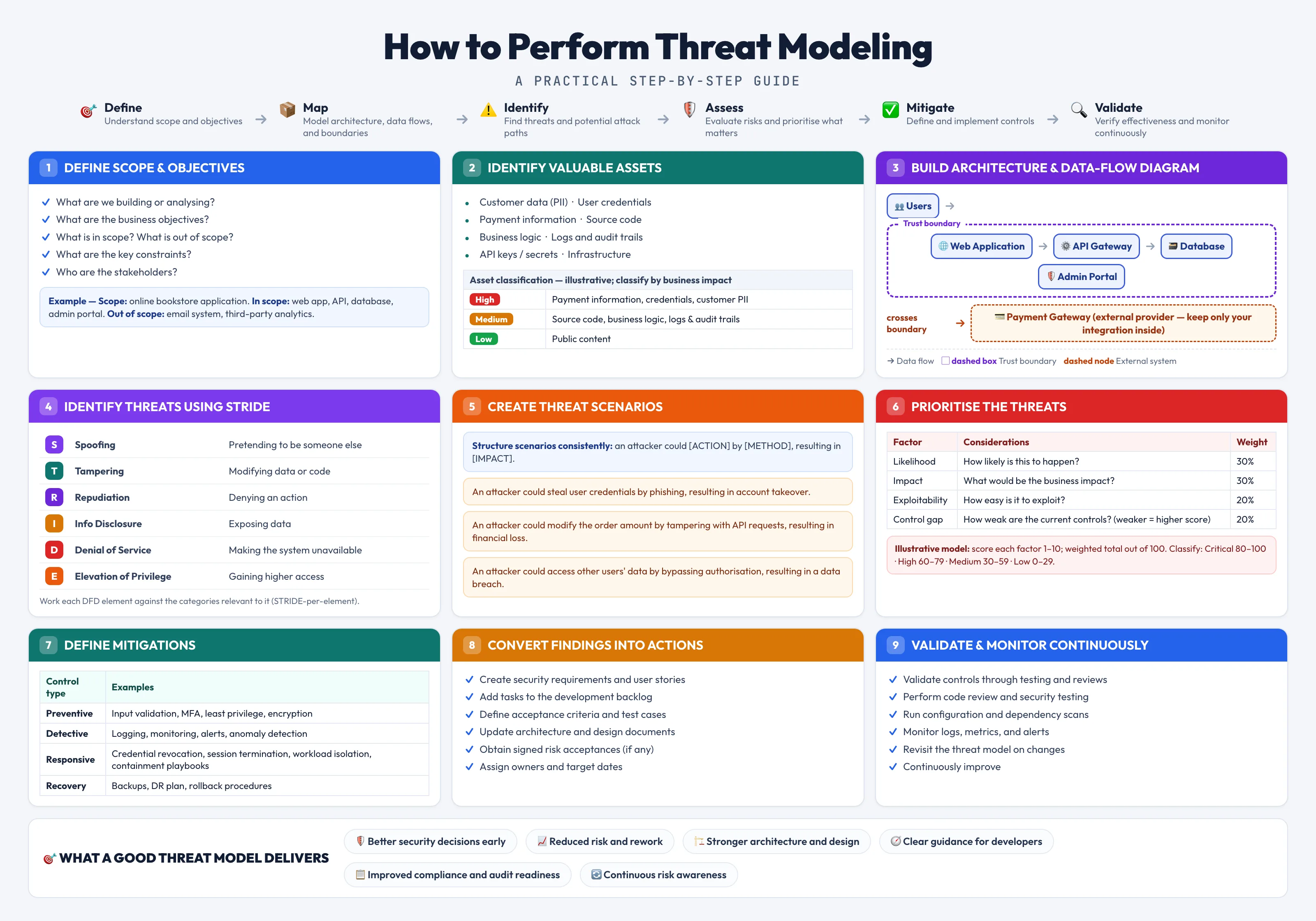
The mechanics are the easy part
The method has a settled shape. A team defines the scope and what is explicitly out of it; identifies and classifies the assets worth protecting; builds an architecture and data-flow diagram with the trust boundaries marked; walks that diagram against a category system such as STRIDE to enumerate threats; turns each significant threat into a concrete scenario (an attacker could do X by means of Y, resulting in Z); prioritises those scenarios with a consistent scoring model; decides on a response for each; converts the responses into backlog items, requirements, and test cases with named owners; and revisits the whole model whenever the architecture changes.
That is a good process, and any competent team can learn it in a week. If technique were the constraint, threat modeling would be a solved problem everywhere. It is not the constraint. The constraint is that this process has to run repeatedly, under delivery pressure, against a moving system, without a dedicated analyst assigned to every team — and that is a leadership problem, not a methodology problem.
Where it lives, and who owns it
The first decision is structural: does threat modeling belong to a central security team, or to the delivery teams themselves? The honest answer for any organisation past a certain size is that a central team cannot be in the room for every design that matters. If your model is “security runs the threat models,” you have quietly capped the number of threat models at the capacity of your security headcount, and you have taught your engineers that thinking about attacks is someone else’s job.
The programs that scale push the modeling into the delivery teams and reposition security as the enabler: security owns the method, the training, the templates, and the hard-case escalation, while the teams building the system own the models for the systems they build. Security’s leverage shifts from doing to raising the floor: a facilitator for the first few sessions, a reviewer for the high-risk ones, and the owner of the standard everyone works to. This is the single highest-leverage structural choice you make, and getting it wrong is why well-funded security teams still miss design flaws: they were never going to be in enough rooms.
Cadence, and the trap of doing it once
Threat modeling done once, at the start of a project, models a system that stops existing the moment development begins. The value decays with every architectural change the model does not capture. But the opposite failure is just as real: a heavyweight threat model demanded for every pull request becomes a tax that teams learn to route around, filling in the template with the minimum needed to clear the gate.
The resolution is to tie modeling to triggers rather than to a calendar or to every change. A new trust boundary, a new class of data entering the system, a new external integration, a change to an authentication or authorisation path, a new internet-facing surface — these are the events that warrant a session, because they are the events that change the attack surface. Routine changes that touch none of those do not. A leader’s job here is to define those triggers clearly enough that teams can self-assess, so the effort lands where the risk actually moves and nowhere else. That is what keeps the program fast enough to survive.
The step where programs live or die
Everything upstream is wasted if the findings go nowhere. The single most common failure I see is a competent, well-run threat-modeling session whose output is a document that changed no code, opened no tickets, and altered no decision. The session happened; the risk did not move.
The discipline that prevents this is unglamorous and non-negotiable: every finding worth acting on becomes tracked, owned, dated work in the same system your teams already use to ship: a backlog item, a security requirement, a test case, or an explicitly signed risk acceptance. A finding that does not become one of those did not happen. And the risk you consciously choose not to fix must be accepted by someone with the authority to accept it, on the record, rather than left as a gap that nobody decided on and everybody will later disown. When you review a threat model as a leader, this is the part to inspect. The diagram and the threat list tell you the team can do the analysis. The tickets and the sign-offs tell you the analysis is going to change reality.
How to know it is working
Threat modeling resists vanity metrics. “Number of threat models completed” measures activity, not risk reduction, and optimising for it produces exactly the box-ticking you are trying to avoid. The signals worth watching are harder and more honest.
Coverage of the changes that matter: of the design decisions in the last quarter that touched a trust boundary or a sensitive data flow, how many were modeled before they shipped rather than after? Traceability: can you follow a sample of findings from the model into merged code, closed tickets, and signed acceptances? And the lagging indicator that matters most: the design-level defects found later, in penetration tests and incidents. A healthy program drives those down over time, because the flaws that used to reach production are now being caught in a conversation. If your pentests keep surfacing architectural problems that a threat model should have caught, the program is not working, regardless of how many models were logged.
Why programs die
The failure modes are consistent, and a leader can watch for each. Threat modeling gets attached to a compliance requirement and becomes an artifact produced to satisfy an auditor, disconnected from design. It gets scheduled too late, after the architecture is frozen, so it can only document risk rather than change it. It has no clear owner, so it happens when someone remembers and not when the system changes. It has no teeth, because findings carry no obligation and compete unsuccessfully with features. Or the diagrams simply rot, because nothing ties the model to the code and no change ever forces an update. Every one of these is an operating-model problem you can design against, and none of them is fixed by teaching the team more about STRIDE.
The whole method on one page
For completeness, because “how do we actually run a session” is the first question a newly responsible team asks, the working sequence is this. Define the scope and what is out of it. List the assets worth protecting and classify them by business impact. Draw the architecture and data flows, and mark the trust boundaries. Walk the diagram with STRIDE and write each significant threat as a concrete scenario: an attacker could do X by means of Y, resulting in Z. Score the scenarios consistently, decide a response for each, and convert every response into a ticket, a requirement, a test case, or a signed risk acceptance. Revisit the model when a trigger fires. That is the entire method; the diagram above expands each step. Everything else in this article is what makes it keep happening.
Threat modeling is not hard to learn and it is not expensive to run. What it demands is a leader who treats it as a program with an owner, a trigger model, and a hard link between findings and delivery, rather than a technique the security team performs on request. Build that, and threat modeling becomes one of the cheapest forms of risk reduction your organisation has. Skip it, and you get a shelf of accurate documents that protected nothing.
Second in a three-part series. Start with Threat Modeling Explained: A Security Leader’s Guide, and continue to Threat Modeling for Cloud: Where Your Risk and Your Budget Actually Move.